Free AI Porn Image Generator 101: From First Prompt to Final Render
Ever thought about how tech turns simple text into stunning visuals? The world of digital art is changing fast, especially in the U.S. Many are discovering how a free ai porn image generator can be a powerful tool for art.
Getting to know these platforms is key to mastering your art. By learning the basics, you can use these tools with confidence and precision. It doesn’t matter if you’re new or experienced; knowing how to write good prompts is crucial.
This guide will clear up the mystery of using a free ai porn image generator safely. We’ll cover the basics of tech settings and ethical use. Get ready to unleash your creativity and bring your ideas to life with advanced software.
Key Takeaways
- Learn the core mechanics behind synthetic media platforms.
- Discover how to write effective prompts for better results.
- Understand the importance of safety and privacy in digital creation.
- Explore the artistic potential of modern automated tools.
- Master the transition from a basic concept to a final render.
Understanding the Technology Behind Free AI Porn Image Generators
Every high-quality image comes from a complex technology called diffusion modeling. This tech is key for most free ai porn image generators today. Knowing how these systems work helps you pick the best tools for your projects.
How Diffusion Models Create Visual Content
Diffusion models start with random static and turn it into images based on your text. They do this by learning to remove Gaussian noise step by step. This process lets them grasp complex details like textures and lighting.
The model compares its work to a huge database of images. It keeps refining until it meets your exact request. This mathematical precision makes AI-generated images look incredibly real.
Distinguishing Between Open-Source Models and Web-Based Tools
When searching for a free ai porn image generator, you’ll find two types: open-source models and web-based tools. Open-source models, like Stable Diffusion, let you use the software on your computer. This gives you total control over your work and privacy.
Web-based tools, on the other hand, are easier to use because they run on remote servers. You just log in and start creating. But, they might have strict rules or cost money, limiting your freedom.
Hardware Requirements for Local Generation Versus Cloud Processing
To run a model on your computer, you need a powerful graphics card (GPU). At least 8GB of VRAM is needed for good results without waiting too long. Without the right hardware, your system might crash or produce poor images.
Cloud services, however, don’t need special hardware because they use strong servers. This makes them great if you don’t have a gaming PC. The table below shows the main differences to help you choose.
| Feature | Local Generation | Cloud Processing |
|---|---|---|
| Hardware Cost | High (Requires GPU) | Low (Browser-based) |
| Privacy | Complete Control | Platform Dependent |
| Customization | Unlimited Access | Limited by Provider |
| Speed | Depends on Hardware | Depends on Server Load |
Selecting the Right Platform for Your Needs
Finding the right free ai porn image generator is key to your creative journey. It affects the quality of your work and how much control you have. This choice is crucial.
Evaluating Popular Free Web-Based Generators
Web-based platforms are great for beginners. They’re easy to use and don’t need special setup or expensive hardware. For example, Ourdream AI makes it simple to tell stories with images.
These sites host the models on their servers. So, you can use a free ai porn image generator right in your browser. But, they might limit what you can create or how often.
Benefits of Using Stable Diffusion Locally
For privacy and total creative freedom, use Stable Diffusion on your own computer. This way, your images stay private. You control the models and settings.
Local use means no limits from public sites. You can try new things and fine-tune your art. It might need a good graphics card, but it’s worth it for the freedom.
Comparing User Interfaces and Ease of Use
The interface you pick affects your daily work. Web tools have simple dashboards for quick use. They’re great if you want to start creating fast.
Local tools like Automatic1111 or ComfyUI need more learning but offer unmatched precision. Think about your skills before choosing. The right tool lets you focus on creating, not fixing.
Setting Up Your Environment for Optimal Results
Starting your AI image generation journey needs a solid foundation. A well-organized workspace is key for your free ai porn image generator to run smoothly. By setting up your system right, you control your creative output better.
Installing Necessary Software for Local Generation
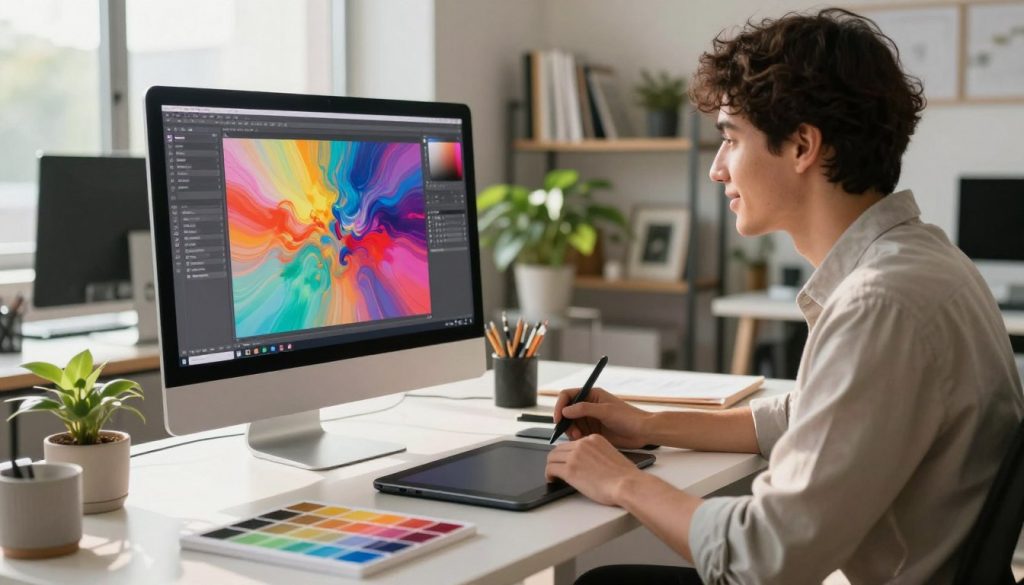
To run models locally, you need specific software. This software connects your hardware to the AI engine. You’ll need to install several key components for your graphics card to work well with the generation software.
Most users need a stable environment for their workflows. Essential tools include:
- Python: The programming language that powers most AI frameworks.
- Git: A version control system used to download and update your software.
- Stable Diffusion WebUI: The main interface for managing local generation tasks.
- NVIDIA CUDA Drivers: Critical for enabling hardware acceleration on your GPU.
Configuring Web-Based Account Settings
If you use a cloud-based free ai porn image generator, focus on account security and preferences. Most platforms let you customize your experience through a settings dashboard.
First, check your profile privacy settings to keep your content private. Many services let you choose whether to make your gallery public. It’s a crucial step for keeping your identity hidden. Also, make sure your API keys are safe if you integrate the tool with other software.
Managing Storage and Privacy Considerations
Effective storage management is crucial when generating high-resolution images. AI models and their outputs can quickly use up a lot of space on your machine or cloud account.
Here are some tips to keep your workspace tidy and secure:
- Organize your folders: Use a clear naming convention for your models and output directories.
- Regular backups: Move your favorite images to an external drive or secure cloud storage.
- Clear cache files: Periodically delete temporary files to maintain optimal performance.
Privacy is a top concern with any free ai porn image generator. Always check if the platform keeps your prompts or images on their servers. If you’re worried about data security, choose platforms that offer local processing or strict zero-retention policies for your media.
Mastering the Art of Prompt Engineering
This beginner tutorial will teach you how to control AI outputs with confidence. Prompt engineering connects your creative ideas to the final digital image. By learning to structure your requests, you can tell the model exactly what to produce.
Structuring Your First Prompt for Success
To get the best results, organize your prompts logically. Start with your primary subject. Then, add details about the environment, action, and style. A clear prompt is like a blueprint for the AI.
“The quality of your output is directly proportional to the clarity of your input.”
Use clear and concise language. Avoid vague terms. Instead, use specific nouns and adjectives to guide the model.
Using Descriptive Keywords for Lighting and Composition
Lighting and composition make an image go from basic to professional. Use terms like cinematic lighting or golden hour to change the mood. Specifying camera angles, like wide shot, helps the AI understand your vision.
Try different keywords in this beginner tutorial. You’ll see how small changes can make a big difference in your results.
Applying Negative Prompts to Refine Your Output
Negative prompts are key. They tell the AI what not to include. This is crucial for avoiding common errors and unwanted artifacts.
Common Negative Prompt Keywords to Avoid Artifacts
Keep a list of negative terms to maintain quality. These ensure your images are clean and correct:
- Bad anatomy: extra fingers, deformed limbs, fused body parts.
- Visual noise: blurry, low resolution, grainy, pixelated.
- Compositional errors: cropped, out of frame, watermark, text.
Using these negative constraints makes your workflow more efficient. Learning these basics quickly improves your digital creation skills.
Advanced Techniques for Instant Render Quality
This beginner tutorial will show you how to improve your AI art. You’ll learn to make your images look professional by adjusting settings. This lets you control the look of your final art.
Adjusting Sampling Steps and CFG Scale
The sampling steps tell the AI how many times to refine your image. More steps mean a clearer image but take longer to process. Try different settings to see what works best for your computer.
The CFG scale controls how well the AI follows your prompt. A lower scale lets the AI be more creative, while a higher scale makes it stick to your words. Here are some tips:
- Lower CFG (5-7): Great for artistic, natural-looking results.
- Higher CFG (9-12): Best for detailed, specific prompts.
- Sampling Steps: 25 to 40 steps usually gives the best quality.
Utilizing LoRAs and Checkpoints for Specific Styles
Checkpoints are the base of your model, setting its look and abilities. Switching to a different checkpoint can change your art from realistic portraits to digital paintings. This beginner tutorial stresses that choosing the right model is key to consistent style.
LoRAs let you add specific ideas to your model without retraining it. They help keep characters consistent or add unique textures. They’re crucial for creating a series of images that look alike.
Implementing ControlNet for Precise Pose Manipulation
ControlNet guides your AI’s structure. You can use a reference image to set the pose of your subject. This ensures your characters look just as you imagined.
ControlNet makes complex poses easier. It’s a key tool for achieving professional results in your beginner tutorial. Learning these advanced techniques saves you time and effort.
Refining and Upscaling Your AI-Generated Images
This part of our beginner tutorial shows you how to make your AI art look great. Even top models can make small mistakes. Learning these steps helps you make sure your work is top-notch.
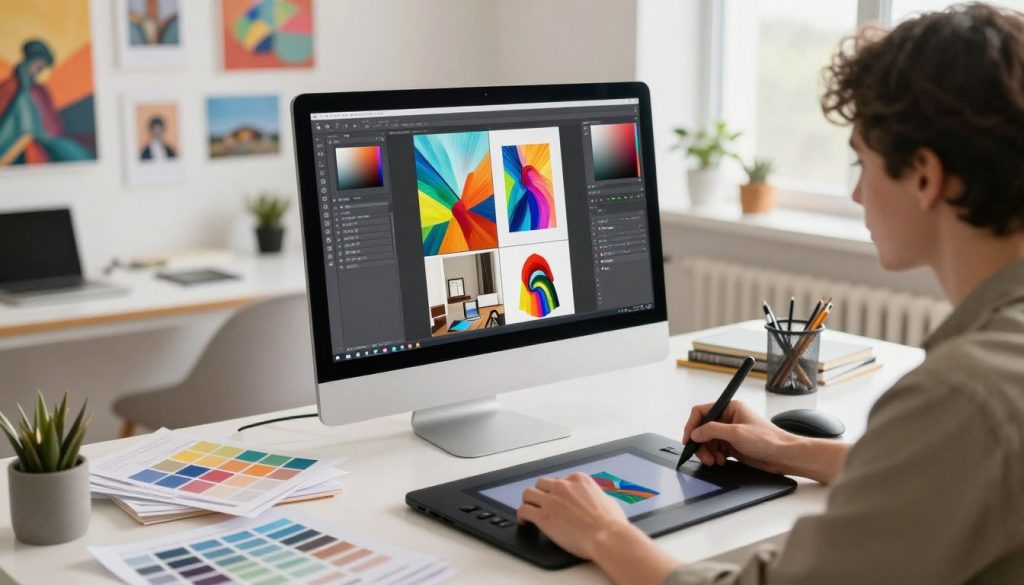
Using Inpainting to Fix Minor Details
Inpainting lets you fix parts of an image without changing the rest. If a character’s hand looks wrong or the background is off, just mask it and try again. This surgical approach is quick and keeps the parts you like.
For the best results, make your mask small and precise. Use a prompt that fits the image’s style to blend the new pixels well. This is great for fixing small details in early versions.
Applying AI Upscalers for High-Resolution Final Renders
After perfecting your image, you might want to make it clearer. AI upscalers add detail and sharpness to low-res images. This is key for printing or showing on high-def screens.
Many tools offer different upscaling models, like ESRGAN or SwinIR. Pick one that fits your art style. Always check the final image for any unwanted noise from upscaling.
Post-Processing Tips for Professional Results
External software can take your work to the next level. Simple tweaks to contrast, saturation, and color can make a big difference. You might also use filters to make the lighting look consistent.
The table below shows common tools and what they do. It helps you choose the right ones for your workflow:
| Tool Category | Primary Function | Best For |
|---|---|---|
| Inpainting | Local correction | Fixing hands and faces |
| AI Upscalers | Resolution boost | Large format printing |
| Photo Editors | Color grading | Final artistic polish |
| Denoising Filters | Texture smoothing | Removing digital artifacts |
Learning these post-processing steps is a big step in this beginner tutorial. With practice, you’ll get better at refining and upscaling images. Keep trying different settings to find what works best for you.
Navigating Ethical Guidelines and Safety Standards
Your journey into AI image creation should always prioritize safety and legal compliance. The excitement of achieving an instant render is great. But remember, technology has rules. Staying informed keeps your creative process safe and productive.
Understanding Platform Terms of Service
Every tool you use has its own set of rules called Terms of Service. These documents tell you what you can and can’t do with the software. Always read these agreements to avoid getting in trouble.
Following community standards is more than just avoiding trouble. It helps create a healthy space for all creators. When you respect these rules, you help the platforms that give you instant render capabilities thrive.
Responsible Use and Content Distribution
How you share your work matters a lot online. Being responsible means thinking about the content you create and its impact. Avoid making images that break safety rules or spread harmful ideas.
Think about the context and audience when sharing your work. Being open and honest is key to ethical sharing. If you use AI for complex visuals, label your work to keep trust with your community.
Protecting Your Digital Privacy While Generating Content
Your personal data is very important and needs protection. Many online tools collect data that could link back to you. Using a VPN or a special email for your accounts adds security.
Be careful not to upload personal photos or sensitive info into any tool. Even for an instant render, never risk your privacy. Keeping your digital life safe lets you explore without worrying about your safety.
| Safety Practice | Why It Matters | Action Item |
|---|---|---|
| Terms Review | Prevents account bans | Read the full ToS |
| Data Privacy | Protects your identity | Use a burner email |
| Ethical Sharing | Builds community trust | Label AI content |
| Content Safety | Ensures platform health | Follow community rules |
Troubleshooting Common Generation Errors
Getting a perfect instant render isn’t always easy. Even with top-notch hardware, you might still run into problems. Knowing how to fix these issues keeps your creative work flowing smoothly.
Resolving Blurry or Distorted Outputs
Blurry images often come from not enough sampling steps or wrong resolution settings. If your instant render looks soft, try upping the sampling steps. Also, make sure your output resolution matches the training aspect ratio of your model.
Distortion can happen if the denoising strength is too high. Lowering this value can help keep your subject’s shape right. Always double-check your VAE settings, as the wrong or missing VAE file can cause blurry colors.
Fixing Anatomical Inconsistencies
Anatomical errors, like extra limbs or wrong hands, are common in AI art. To get better instant render results, use specific negative prompts. Adding terms like “extra fingers” or “bad anatomy” to your prompts can help a lot.
For more control, use ControlNet to guide the skeletal structure of your subjects. This tool helps avoid awkward limb placement. If a part still looks off, use inpainting to fix just that area.
Managing Resource Limitations and Generation Timeouts
Generation timeouts happen when your hardware can’t handle complex tasks fast enough. If you’re working locally, watch your VRAM usage to avoid overloading your GPU. Cutting down your batch size or image resolution can prevent crashes and keep your instant render workflow smooth.
Cloud users should check their connection and platform limits. If you often hit timeouts, try shortening your prompts or using lighter models. The table below shows common problems and how to fix them for a smooth experience.
| Issue Type | Primary Cause | Recommended Fix |
|---|---|---|
| Blurry Output | Low Sampling Steps | Increase steps to 30-50 |
| Anatomical Errors | Poor Prompting | Use negative prompts & ControlNet |
| Generation Timeout | VRAM Overload | Reduce batch size or resolution |
| Color Artifacts | Missing VAE | Install/Select correct VAE file |
Conclusion
You now know how to use AI image generation. This lets you turn simple text into amazing pictures easily.
Keep practicing to get better at your art. Every change you make gets you closer to your goal.
Try out different tools like Stable Diffusion to see how they work. Always remember to be safe and ethical.
As you get better, you’ll make even better pictures. Keep exploring what you can do with your tools.
Join the AI art community to share and learn. Your creative journey is just starting, and there’s so much to discover.
FAQ
What is the best way to start using a free ai porn image generator for personal projects?
Start by choosing between a web-based platform or a local setup. For beginners, cloud services like Ourdream AI are easy to use. They offer an instant render without the need for complex setup.
Once you get the hang of prompt engineering, you can try local tools like Stable Diffusion. These offer more privacy and customization options.
Do I need a powerful computer to achieve an instant render of high-quality images?
Not always. Cloud-based tools handle the heavy work on their servers. This means you can create high-quality images on standard laptops or even mobile devices quickly.
How does prompt engineering affect the quality of my AI-generated art?
A: Prompt engineering is key to your art’s quality. Use specific keywords for lighting, composition, and style to guide the AI. Also, use negative prompts to avoid AI mistakes, ensuring your art looks clean and realistic.
What are LoRAs and checkpoints, and why should I use them?
A: Checkpoints are the core models for your image’s look. LoRAs are smaller plugins for specific styles. Together, they help maintain character consistency and achieve unique artistic styles.
Can I fix anatomical mistakes or distorted faces after the image is generated?
Yes, you can refine your work with inpainting. This technique fixes specific areas, like hands or faces. Also, AI upscalers can make your low-resolution drafts look professional.
What are Sampling steps and the CFG scale in this beginner tutorial?
A: Sampling steps are the AI’s iterations to refine the image. More steps mean more detail but take longer. The CFG scale controls how closely the AI follows your prompt. A higher scale means more literal, while a lower scale allows for creativity.
How do I gain precise control over the poses of my subjects?
Use ControlNet for precise pose control. It lets you use reference images or wireframes to set exact postures. It’s essential for those who need precise pose manipulation and creative control.