The Free Workflow: From First Image to Finished Set Without Spending a Credit (2026)
Quick Verdict
The short version: a free workflow is not a trick and not a trial. Sur ce site, image generation is free with no registration, aucun e-mail, aucune vérification par téléphone, et aucune carte bancaire, and a finished set is just that free generation run in the right order: one first image, a few free variations, a free upscale, a careful selection, and a saved set you can reuse. The only steps that cost credits are the optional ones — the editor at 49 credits and face swap at 26 — and the workflow works without them. The free workflow is a real workflow, not a demo of one, and the only thing it cannot do is the thing free was never meant to do: fix an image that was wrong from the start.
Contents
- What “Free” Actually Covers Here
- The Workflow in Six Steps
- Step One: The First Image
- Steps Two and Three: Variations and Upscaling
- Steps Four and Five: Selection and the Set
- Step Six: Saving and Reusing
- What the Free Workflow Costs
- Consent and the Line You Do Not Cross
- Verdict final
- Frequently Asked Questions
| Step | Tool | Free here? | Paid alternative |
|---|---|---|---|
| First image | Générateur de porno IA | Oui, Gratuit | — |
| Variations | Re-roll, same prompt | Oui, Gratuit | — |
| Upscaling | Image Upscaler | Free tier available | Image-to-image pass, 49 crédits |
| Fix one flaw | Image Editor | Non | 49 crédits |
| Face swap | Face Swap Pro | Non | 26 crédits |
| Vidéo | Video Generator | Non | 351 crédits (5 sec) / 561 (8 sec) |
Read the table from the top down. The first three steps — the ones that produce the finished set — are free. Everything below them is optional. A workflow that needs the paid rows is not a free workflow. This one does not.
1. What “Free” Actually Covers Here
Free means different things on different sites, and most of the confusion in this space comes from never checking which meaning is on offer. On this site the meaning is written on the homepage, in plain words: image generation is free, sans inscription, aucun e-mail, aucune vérification par téléphone, et aucune carte bancaire, and no limits on the free generation itself. That is the claim, verified on the homepage on 13 Nov. 2026, and it is the whole foundation of this guide.
What free covers is generation. It does not cover everything on the site. The image editor, face swap, and video generation are paid tools with credit prices, and they are priced in the table above. That is not a contradiction. A free workflow is a workflow built from the free parts, and the honest version of it says clearly which parts are free and which are not, instead of pretending the paid parts do not exist.
Free does not cover a bad first image, and that matters more than the prices. No amount of free upscaling or free variation will save a first image whose prompt was confused or whose subject was unclear. The workflow works because the first step is done well, not because the later steps are free. If the first image is wrong, the cheapest fix is a new first image, not a paid repair.
2. The Workflow in Six Steps
The workflow has six steps, and the order is the workflow. First image, variations, upscaling, selection, the set, saving. Skip the order and the workflow falls apart: upscaling before selection means upscaling images you will throw away, and selecting before varying means choosing from a set of one. Each step has one job, and each step hands its output to the next.
The whole workflow fits in one sitting of about half an hour, and most of that time is looking, not generating. Generation is fast. Looking is slow, and looking is the work. Rush the looking and you end up with a folder of near-identical images and no set. Look properly and you end up with four images that belong together.
Before you start, decide what the set is for. A set for a profile picture, a set for a wallpaper, and a set for a series all need different things, and the first image changes with the answer. “Un set” is not a brief. “Four images of the same character, same style, for a profile series” is a brief. Write the brief down before you generate anything.
3. Step One: The First Image
The first image is the most important image in the workflow, because every later step is a variation on it. Write one prompt with one idea per sentence, and name the single most important thing about the image: the subject, la lumière, ou l'ambiance. Une chose. A prompt that tries to name everything names nothing, and the generator will pick for you, badly.
Generate the first image and look at it at full size before you do anything else. Ask three questions: is the subject clear, is the light doing what the prompt asked, and is there anything broken — a hand, un visage, a background smear. If something is broken, do not fix it. Regenerate. The first image is free, and a free regeneration is cheaper than any repair. If the subject is unclear, rewrite the prompt to one idea and regenerate. Only when the first image is sound do you move on.
There is a temptation at this step to keep generating until the first image is perfect. Resist it. The first image needs to be sound, not perfect. Perfect is the enemy of the workflow, because the workflow’s job is to make a set, and a set needs four good images, not one flawless one. When the first image is sound, stop and move to variations.

4. Steps Two and Three: Variations and Upscaling
Variations are free re-rolls of the same prompt, and their job is to give selection something to choose from. Generate three or four variations of the first image — same prompt, new seeds — and stop. More than four variations does not give you a better set. It gives you a harder selection, because the differences between the images get smaller and your eye gets tired. Three or four is the number where choice stays real.
Look at the variations at thumbnail size first. The thumbnail test works here exactly as it works everywhere: if a variation does not read at thumbnail size, it will not read as a finished image either. Pick the two variations that survive the thumbnail test and set the rest aside. You are not deleting them. You are not choosing them. A set needs four images, and you now have three candidates: the first image and two variations.
Upscaling comes next, and only for the candidates. The free upscaling tier handles the common sizes, and it is enough for a finished set in most cases. Upscale the three candidates and check the results at full size. If an upscale introduces a smear, drop that candidate and upscale the next best variation instead. Do not upscale the whole folder. A keeper is decided before the upscale, not after it.
5. Steps Four and Five: Selection and the Set
Selection is the step where a folder becomes a set, and it has one rule: the set must belong together. Four images belong together when they share a subject, a style, and a light. If one image has a different light, it is not part of the set, no matter how good it is on its own. Put it in a different set, or save it for later. A set is not four good images. It is four images that look like they were made on purpose, together.
The practical test is simple. Lay the four candidates out in a row and look at them as one picture. If your eye moves smoothly across the row, the set holds. If your eye stops on one image and asks why it is different, that image is the odd one out, and the set is better without it. Replace it with the next best variation, or run the set with three images. Three images that belong together beat four that do not.
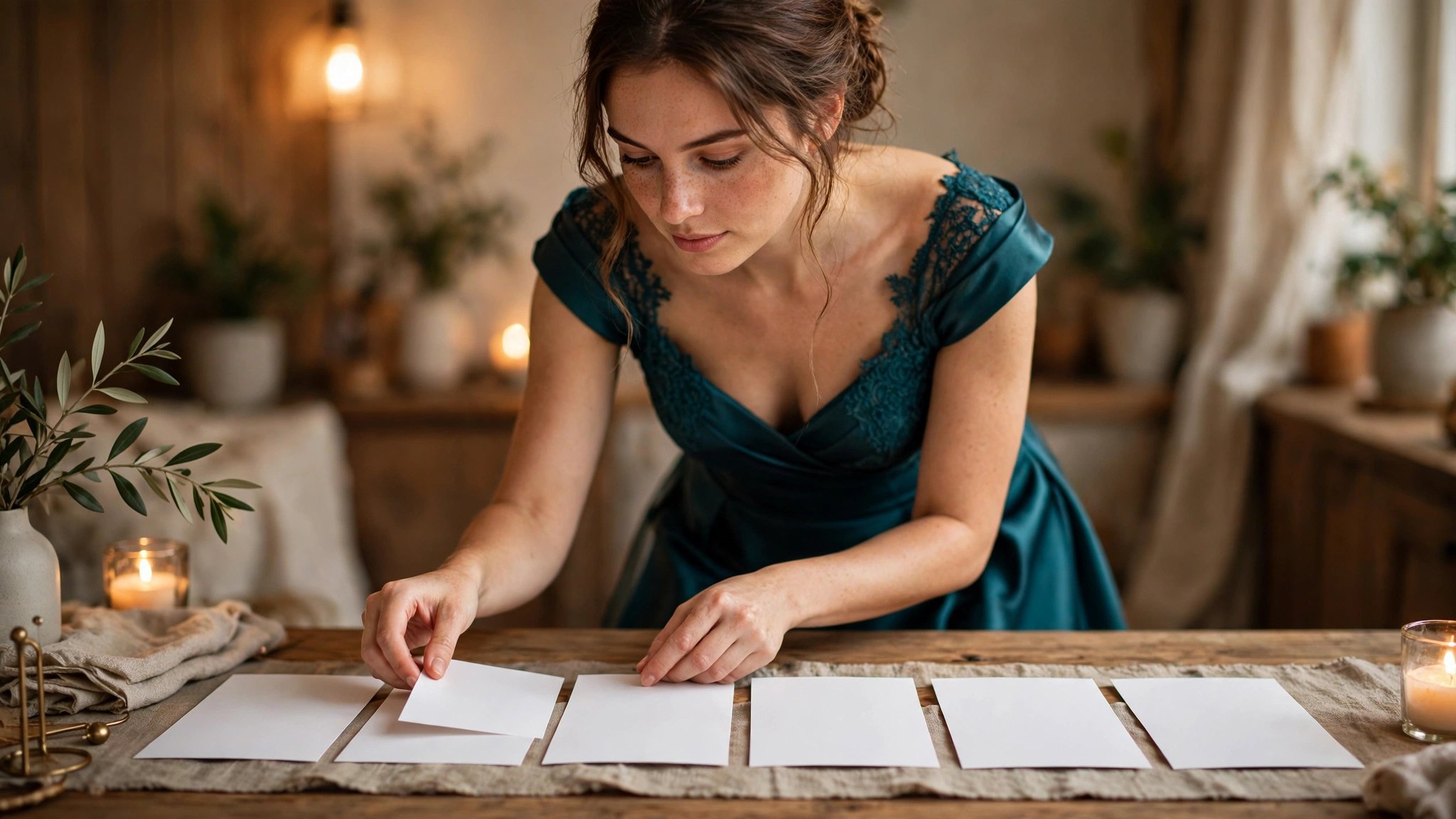
There is a second test, and it is about the set’s purpose. Go back to the brief you wrote before the first image. Does the set do what the brief asked? A profile series needs four images of the same character. A wallpaper set needs four images that work at large size. A series needs four images that tell a sequence. If the set fails the brief, it is not finished, even if every image in it is good.
6. Step Six: Saving and Reusing
A finished set that is not saved properly is a set you will lose. Save the four images with names that say what they are: the brief, le style, and the date, in the filename. “Profile series, teal gown, 13 Nov.” is a name you can find again. “Image 4 final final” is a name you will never find again, and it will sit in the folder next to eleven other images with the same name.
Save the prompt with the set, in the same folder, in a text file with the same name. The prompt is the recipe, and a set without its recipe cannot be extended. When you want a fifth image in the same set next week, the saved prompt is what makes it possible.
Reuse is the point of the whole workflow. A finished set is not the end of the work. It is the start of the library: the collection of sets, prompts, and briefs that makes the next free workflow faster than this one. The first set takes half an hour. The second takes twenty minutes, because the brief format, the selection test, and the saving habit are already in place.
7. What the Free Workflow Costs
The free workflow costs zero credits. That is the whole point, and it is worth saying plainly: the first image, the variations, the free upscaling, the selection, the set, and the saving are all free on this site. No registration, aucun e-mail, aucune vérification par téléphone, aucune carte bancaire. Prix vérifiés 13 Nov. 2026.
The paid steps are optional, and their prices are worth knowing so you can decide deliberately. The image editor costs 49 credits for a fix: $0.98 sur le $19.99 pack of 1,000 crédits, $0.59 sur le $59.99 pack of 5,000 crédits. Face Swap Pro costs 26 crédits: $0.52 sur le $19.99 pack, $0.31 sur le $59.99 pack. A video template costs 351 crédits pour cinq secondes ($7.02 / $4.21) or 561 credits for eight seconds ($11.22 / $6.73). None of these are part of the free workflow, and none of them are needed to finish a set.
The honest comparison is not between the free workflow and the paid tools. It is between the free workflow and the unstructured free generation most people do instead: generate until the folder is full, keep everything, finish nothing. That costs zero credits too, and it produces nothing you can use. The free workflow costs the same zero credits and produces a finished set.
8. Consent and the Line You Do Not Cross
A free workflow is not a loophole. Everything in this guide applies only to images of yourself, or to fully fictional adult characters you created. Never use the free generation to practise on a real person’s photo without their clear consent, and never generate images of a real person in sexualised situations, whether or not they are famous. Free does not mean unaccountable: the consent rule applies to every generation, paid or free, test or finished set. If you are not sure you have consent, you do not have it, and the image does not get made.
The same rule covers the library. Do not keep a library of sets built from other people’s faces, and do not share a free set that identifies a real person. The free workflow is a private tool for improving your own work. Keep it private, keep it fictional, and keep the people in your images the people you have every right to imagine.
Verdict final
The free workflow is real, not a demo: the first image, the variations and the free upscale cost zero credits, sans inscription, no email and no card. The editor at 49 credits and Face Swap Pro at 26 are optional, and the finished set does not need them.
The boundary is honest. Free generation builds a set from a good first image, but it cannot fix an image that was wrong from the start. Start well and it is enough; start badly and no free step will save it.
Frequently Asked Questions
Is the free workflow really free, with no catch?
Sur ce site, Oui: image generation is free with no registration, aucun e-mail, aucune vérification par téléphone, et aucune carte bancaire, and no limits on the free generation itself, as stated on the homepage and verified on 13 Nov. 2026. The editor, face swap, and video tools are paid, and this guide says so plainly. The catch is not a hidden price. It is that the workflow only works if the first image is sound.
How many variations should I generate?
Three or four. More than four makes selection harder, not better, because the differences between images get smaller and your eye gets tired. Three or four variations plus the first image gives you four candidates, which is exactly the size of a finished set.
When is the editor worth 49 crédits?
Once, for one named flaw in an otherwise finished image: “fix only the left hand, keep everything else”. If the image needs two or three editor passes, it is not worth fixing. Regenerate the first image for free instead and start the workflow again.
Can I make a video from a free set?
Oui, but video is not part of the free workflow. A video template costs 351 credits for five seconds or 561 pendant huit secondes. The free workflow produces the stills; the video is a separate, paid step you take only when the set is already finished.
What if my first image keeps coming out wrong?
Rewrite the prompt to one idea per sentence and name the single most important thing about the image. If three free regenerations all fail the same way, the prompt is confused, not the generator. Cut the prompt in half and try again.
How do I reuse a finished set later?
Save the prompt in a text file with the same name as the set, in the same folder. When you want a fifth image next week, the saved prompt is what makes it match. A set without its saved prompt cannot be extended.
Keep Reading
- The Free Library: Building a Reusable Image Set From Free Generations (2026) — what to do with finished sets once you have them: the library that makes every next workflow faster.
- Which Styles Work Best for Free? A Free-Tier Style Guide (2026) — pick the style before you start the workflow, so the first image is already pointed in the right direction.
- Tailles d'images porno IA gratuites: Quelle résolution pour un fond d'écran, Publication & Profil (2026) — the brief decides the size: which resolution each use actually needs, before you upscale anything.