8K Without the Price Tag: Mastering the Free Porn AI Generator
Ever thought you could make studio-quality visuals without breaking the bank? Many think you need expensive gear or software to get high-quality results. But, the world of digital creation is changing fast.
Even though many tools aren’t as good as top models like Imagen 1.5, you can still get amazing results. By learning to use a free porn ai generator 8k, you can make professional content from home. The key is to fine-tune your prompts and know your setup well.
You don’t have to accept low-quality, watermarked, or glitchy outputs. With the right strategy, your creative potential knows no bounds. Using a free porn ai generator 8k wisely lets you avoid common issues and create work that’s on par with paid studios.
Key Takeaways
- High-quality results are possible without expensive monthly fees.
- Prompt engineering is the most critical factor for visual fidelity.
- Technical calibration helps you overcome limitations in older models.
- Avoiding common glitches requires patience and iterative testing.
- Professional-grade output is accessible to anyone with the right strategy.
Understanding the Technology Behind Free Porn AI Generator 8K
Looking into a free porn ai generator 8k shows a world of math and neural networks. You might ask how a text prompt turns into a beautiful, high-resolution image. Learning about these basics lets you fine-tune your creations.
How Diffusion Models Create High-Resolution Imagery
The diffusion model is at the core of these systems. It starts with random noise and turns it into a clear image. Over thousands of steps, it learns to spot patterns in your text prompts.
This tech is great at handling complex scenes. It makes sure even moving parts look sharp and clear. This is key for making realistic, detailed content.
The Role of Latent Space in Detail Generation
To make 8K images, the system uses latent space. It doesn’t start with every pixel in high detail. Instead, it works with a compressed version. This lets it focus on the most important details.
In this space, a free porn ai generator 8k can create fine textures like skin or fabric. After setting the main image, it brings back the details. This two-step method leads to unparalleled clarity without needing a huge computer.
Setting Up Your Hardware and Software Environment
Starting with a solid technical base is key when using a free porn ai generator 8k. You can choose between local hardware for privacy or cloud services for ease. Your choice affects how fast and clear your results will be. A good setup helps avoid slowdowns and crashes during long tasks.
Minimum System Requirements for Local Generation
For high-resolution models, you need strong graphics. A dedicated GPU with 12GB VRAM is essential for 8K work. Without it, you might face “out of memory” errors that stop your work.
Reliability is crucial with local tools like RuinedFooocus. It’s designed for your machine, saving on cloud costs. Keep your drivers up to date for smooth operation with new AI models.
Choosing the Right Web-Based Interfaces
The right interface lets you control your workflow. Some platforms are simple, while others offer detailed settings. Your interface connects your ideas to your computer’s power.
Comparing Stable Diffusion WebUI and ComfyUI
Stable Diffusion WebUI is easy to use, perfect for beginners. It has a tabbed layout for basic settings. ComfyUI, on the other hand, has a node-based system for more complex tasks.
| Feature | Stable Diffusion WebUI | ComfyUI |
|---|---|---|
| Learning Curve | Beginner Friendly | Advanced/Technical |
| Workflow Control | Standardized | Highly Customizable |
| Resource Usage | Moderate | Optimized/Efficient |
| Best For | Quick Generation | Complex 8K Pipelines |
Mastering Prompt Engineering for High-Fidelity Results
To get stunning images, you need a smart way to write prompts. When using a free porn ai generator 8k, how clear your images are depends on your prompt. By being precise, you can go beyond basic images and create professional ones.
Structuring Your Prompts for Maximum Detail
A good prompt is like a map for the AI. Start with the main subject, then the setting, lighting, and style. Being specific helps avoid blurry or unclear images.
Organizing your ideas makes the AI focus on what’s important. Here’s a simple way to do it:
| Component | Purpose | Example |
|---|---|---|
| Subject | Defines the core focus | Portrait of a woman |
| Environment | Sets the background | Soft-lit bedroom |
| Lighting | Adds depth and mood | Cinematic rim lighting |
| Quality Tags | Ensures high fidelity | 8k, masterpiece, raw photo |
Using Negative Prompts to Eliminate Artifacts
Negative prompts are just as important as your main instructions. They tell the AI what not to do, keeping images clear. If you see glitches, add specific terms to avoid them.
Issues like extra limbs or blurry faces often come from missing negative prompts. By telling the free porn ai generator 8k what to avoid, you get better images. This small change makes a big difference.
Essential Keywords for Photorealistic Textures
To make images look real, use technical terms for details. Words like subsurface scattering, skin pores, and fine hair detail help the AI create realistic textures. This ensures your images look real, even up close.
Selecting the Best Free Models and Checkpoints
Your choice of model is key to every image you make. Not all AI models are the same. So, picking the right checkpoint is crucial for your ultra hd workflow. This choice affects the detail, skin texture, and lighting in your images.
Navigating Civitai for High-Quality Models
Civitai is the main place for the AI generation community. It has thousands of user-trained checkpoints. To find top assets, use the platform’s filters to narrow your search.
- Filter by Model Type: Choose “Checkpoint” files for software compatibility.
- Sort by Rating: Pick models with high ratings and positive feedback for reliability.
- Check Sample Images: Look at the creator’s images to see if the model meets your style.
Choosing models trained on high-resolution datasets is key for your ultra hd workflow. These models often have better skin texture and lighting than basic models.
Understanding Model Merging for Custom Aesthetics
Model merging lets you mix the best parts of two or more checkpoints into one file. This is great for combining photorealistic skin with cinematic lighting.
You can merge models in web-based interfaces using weighted averages. This lets you control the look of your images. It’s a crucial skill for a professional ultra hd workflow, offering endless creative options.
Implementing an Ultra HD Workflow
Creating a solid ultra hd workflow is key to making high-quality images. A set process removes the uncertainty from your work. This way, every image meets your high standards and saves time.
Step-by-Step Generation Process
Start with a solid base model for high-resolution images. Choose your target aspect ratio early. This sets the stage for your work.
Consistency is crucial for professional results.
Configuring Sampling Steps and CFG Scale
Sampling steps and CFG scale are vital for clear images. More steps mean better detail, but too many slow things down. Most find 30 to 40 steps ideal for quality and speed.
The CFG scale affects how closely the AI sticks to your prompt. Too high, and you might get unwanted effects. Aim for 7 to 9 for the best results in complex scenes.
Managing VRAM Usage During High-Resolution Renders
VRAM is a big challenge when scaling up images. Use tiled diffusion or latent upscaling to handle it. These methods split the image into parts, letting your GPU handle it without crashing.
Keep an eye on background apps to free up memory for your work. Closing unused tabs or software helps. This way, you can create high-quality content without memory issues.
Advanced Upscale Tips for 8K Clarity
Turning standard AI outputs into sharp, professional 8K images is a skill every creator should master. It needs a solid ultra hd workflow to keep details sharp and textures fine. Follow these upscale tips to make your final images look sharp and real.
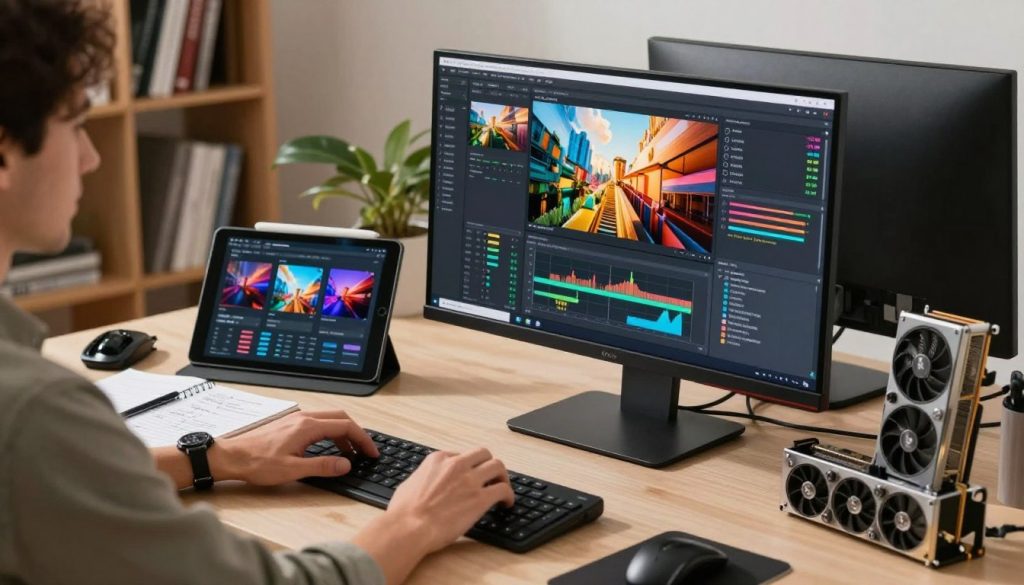
Utilizing Hires. Fix for Initial Upscaling
The Hires. Fix feature is key for high-resolution work. It starts with a lower-resolution image and then upscales it. This avoids the common problem of distorted images found in large-scale generations.
When using this tool, choose your denoising strength wisely. A value between 0.3 and 0.5 is best for adding detail without changing the image. This step is crucial for a clean, high-quality base before more detailed processing.
Applying Ultimate SD Upscale for Massive Resolution
With a solid base, the Ultimate SD Upscale extension is your go-to for 8K. It breaks your image into smaller parts, processes them, and then stitches them back together. This method avoids VRAM limits that could crash your system during big renders.
“Resolution is not just about pixel count; it is about the density of information that makes an image feel real and tangible to the viewer.”
Selecting the Best Upscalers for Skin and Fabric
Picking the right upscaler model is key for realistic textures. Different models are trained for specific surfaces. Using the wrong one can make textures look plastic or too smooth. Check the table below to find the best upscaler for your needs.
| Upscaler Model | Best For | Texture Quality | Processing Speed |
|---|---|---|---|
| 4x-UltraSharp | General Detail | High | Moderate |
| R-ESRGAN 4x+ | Fabric & Clothing | Very High | Slow |
| 4x_NMKD-Siax | Skin & Portraits | Excellent | Moderate |
For skin, choose a model that keeps pores and natural imperfections. For fabric, look for models that highlight weave patterns and thread details. Using these choices in your ultra hd workflow will greatly improve your work’s quality.
Refining Skin Textures and Lighting Effects
To get a realistic look, you need more than just high resolution. You also need to focus on skin textures and lighting. Even with high resolutions, images can look flat or fake if the details are lacking. By using upscale tips, you can make your images look like high-end photos.
Using LoRAs to Enhance Realism
LoRAs, or Low-Rank Adaptation models, are great for adding style to your images. These small files give the AI the knowledge to create realistic skin pores, subtle blemishes, and natural skin tones. By choosing a high-quality skin-texture LoRA, you can avoid the default smoothing found in standard models.
When using these models, make sure the weight is right to avoid over-processing. A weight between 0.6 and 0.8 works best for keeping skin natural. This way, your images will have a human touch that’s often missing.
Adjusting Lighting Parameters for Cinematic Depth
Lighting is key to making an image look professional and cinematic. Try using keywords like “rim lighting,” “volumetric fog,” or “soft studio lighting” to add depth. These changes help make the subject stand out, giving the image a three-dimensional feel.
For the final touches, use upscale tips to fine-tune how light interacts with textures. Adjusting contrast and shadow density in your workflow adds polish. The table below shows how different lighting setups can change your AI-generated content’s look.
| Lighting Style | Primary Effect | Best Use Case |
|---|---|---|
| Rim Lighting | Separates subject from background | Dramatic portraits |
| Soft Diffused | Reduces harsh shadows | Natural skin textures |
| High Contrast | Adds cinematic intensity | Artistic, moody scenes |
| Golden Hour | Provides warm, organic glow | Outdoor environments |
Post-Processing Techniques for Professional Polish
Turning raw AI output into top-notch content needs careful post-processing. Even if your first try looks great, small tweaks make a big difference. These final steps make your work clear and detailed.
If you’ve already used our upscale tips, your image should be high-resolution. Now, focus on the small details that make your project feel real and impactful.
Color Grading and Contrast Adjustments
Color grading sets the mood of your image. By tweaking shadows, midtones, and highlights, you can achieve a cinematic feel. Proper contrast management is key to make your subject stand out.
Adobe Lightroom or DaVinci Resolve have great tools for these adjustments. Aim for a balance that brings out skin tones and keeps blacks deep. Subtle changes in color can greatly affect the scene’s realism.
Removing Noise and Artifacts with External Tools
AI generation can sometimes leave behind noise or minor artifacts. These small issues are hard to spot but show up on high-resolution screens. Using external software is the best way to fix these problems.
Topaz Photo AI or similar plugins are great for this. They remove digital grain without losing the textures you worked on. Adding these upscale tips to your workflow makes every pixel sharp and clean.
Remember, less is often more when using these filters. Over-processing can make your image look fake. Always check your work at 100% zoom. A gentle touch will keep your 8K imagery natural while adding that polished finish.
Troubleshooting Common Generation Errors
When your high-resolution projects fail to render, knowing how to diagnose the issue is key. Even the most advanced AI generation setups face technical hurdles. By identifying these bottlenecks, you can keep your creative process moving without delays.
Fixing Distorted Anatomy and Facial Features
Anatomy glitches often occur in complex poses. The model struggles to map limbs correctly. You can often resolve these issues by adjusting your prompt weights or using specific ControlNet models to guide the skeletal structure.
If you notice persistent facial distortion, consider applying in-painting to regenerate only the affected area at a higher resolution. Effective upscale tips during post-processing can also help. Using a dedicated face restoration tool often provides the final polish needed for professional results.
Always verify that your base model is trained to handle the specific pose you are attempting to generate.
Resolving Out-of-Memory Crashes
Out-of-memory crashes are a common issue when pushing your hardware to its limits. These errors typically happen when your GPU runs out of VRAM while processing large tensors. To prevent this, you should optimize your batch size and reduce the number of concurrent processes running in the background.
If you continue to experience crashes, try utilizing tiled diffusion or lowering your precision settings to FP16. Implementing smart upscale tips, such as breaking your image into smaller segments, allows you to achieve 8K clarity without overwhelming your system. Consistency in your workflow settings will ultimately lead to fewer interruptions and more successful high-fidelity outputs.
Conclusion
Creating high-quality images is a mix of technical skill and creative eye. You now know how to use tools like Stable Diffusion and Civitai models. This knowledge is key to mastering complex workflows.
Getting better at this takes practice. Using the right tips helps keep your images clear, even at huge sizes. These methods turn simple images into detailed works of art that impress everyone.
Trying new things is crucial. By tweaking settings, you can see what your equipment can really do. Keep working on your prompts and trying new things to find your unique style.
You’re all set to make amazing visuals that match your vision. Share your work with others to get feedback and learn. Your hard work will pay off, and you’ll see your skills grow.
FAQ
What is the best free porn ai generator 8k for beginners?
For beginners, RuinedFooocus is a great choice. It makes high-quality 8K images without a steep learning curve.
How can I ensure realistic skin textures in my AI art generator?
For realistic skin textures, use specialized LoRAs from Civitai. Include keywords like “skin pores” and “subsurface scattering” in your prompts.
Do I need an expensive GPU to use these upscale tips?
You don’t need a top-of-the-line GPU. Use Ultimate SD Upscale with tiled rendering to achieve 8K on mid-range hardware.
Can I use deepfake technology with these 8K generators?
Yes, you can use deepfake technology. Tools like Reactor or Roop extensions in Stable Diffusion WebUI can combine face-swapping with high-resolution generation.
What are the best sampling methods for high-fidelity adult content?
DPM++ 2M Karras and Euler a are the best sampling methods. They balance speed and detail for photorealistic images.
How do I fix "Out of Memory" errors during an 8K render?
To fix OOM errors, use the “Tiled VAE” option and the “lowvram” command line argument if your GPU has less than 10GB of memory.